
How does my size, range of motion, and equipment settings in Pilates affect me?
Learn how Kinetics applies to Pilates. Photo Credit: Freepik.com
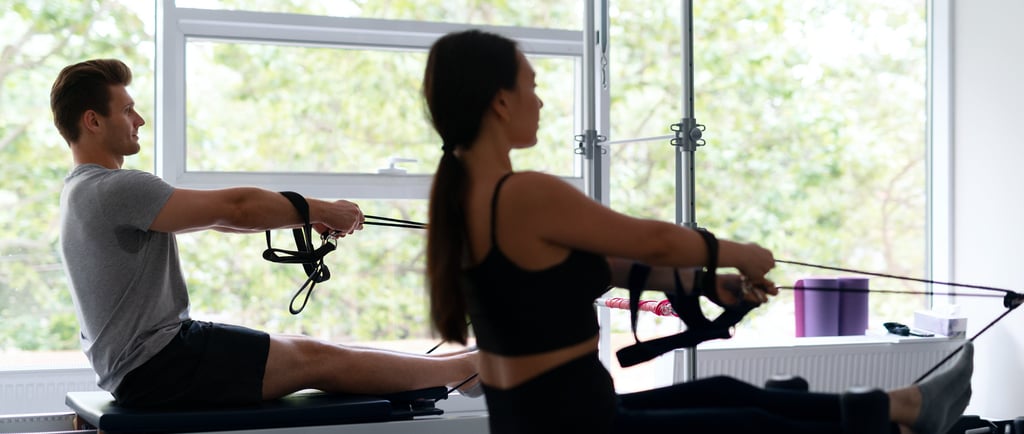
Photo Credit: Freepik.com
Did you know that two individuals can use the same spring tension and each have very different experiences? And it's not for the reason that most people would think.
It would be easy to think that one spring for someone smaller and weaker could feel heavier and more difficult to move than that same spring color for someone much larger and stronger, but science tells us otherwise.
In order to understand this, you have to know how the equipment works as well as some basic principles of kinetics.
Pilates Equipment Physics
Creator, instructor, and engineer Kaleen Canevari does a fantastic job of explaining the physics behind how and why Pilates apparatus work and we encourage you to explore her page to learn more about that, while we focus on the kinetics portion on this page. The TLDR for the purposes of the rest of this discussion is that the more a Pilates spring stretches, the heavier it gets.
Human Kinetics
In the study of Kinetics, as it specifically relates to body movement, a force can produce, slow down, or stop a movement. Broken down further, an internal force is one that the body creates. An external force is from outside the body. Gravity, spring tension, or tactical feedback from an instructor are three examples of external forces you may experience in a Pilates class.
When we think about movement around a joint, the result of an internal and external force is measured as torque. Torque is the force that creates movement at the joint, which in turn, moves the body. In other words, your bicep contraction (internal force) as it bends your elbow while holding a weight (external force) produces torque to create the movement.
The length of the bone from the joint (referred to as the moment arm) will also affect the total torque, even when the external force is the same.
For example, let's consider someone who has a forearm length of 11 inches long vs someone with a forearm that is 8 inches long. If both were given the same 15 lb. weight and asked to do a bicep curl from full extension of the elbow to a 90 degree bend, the person with the 11 inch forearm would have to create more torque than the person with the 8 inch forearm to do so. (Assuming the two have the same strength) the 15 lb. weight would be more difficult for the individual with the longer forearm because it requires more torque (effort.) Similarly, if someone chose to only extend their arm halfway, less torque would be required to bend the elbow to 90 degrees, therefore feel easier to that individual.
Kinetics and Pilates
Now to complicate things even further from the perspective of spring-based Pilates equipment-- the spring tension is not constant and the further you stretch the spring, the heavier it gets.
This means that if the set up requires both people to sit on the reformer a distance relative to have their arms extended without slack in the ropes to begin, and the person who has a forearm length of 11 inches also stretches the spring further further than the person who has a forearm length of 8 inches, the amount of torque is even greater since the arm moment and the external force are now both greater.
If we think about this on the mat with no equipment, the same principles apply. In this case, your external force is gravity. Let's pretend these same two individuals are on their backs with their legs extended straight. One has a leg length of 32 inches and the other has a leg length of 38 inches. For the purposes of this example, let's pretend their strength is equal, their legs are the same weight and their torsos are also the same size, despite their leg length differences. It will require more torque for the individual with the longer leg length to lift their legs to 90 bend at the hip compared to the individual with a 32 inch leg length, and will there therefore be more challenging for the individual with the longer legs.
So what does this all mean for Pilates teachers and students?
As a student, it's always important to remember not to compare your range of motion or spring color to your neighbors' unless you are prepared to do some math and physics in your head at the same time.
As a teacher, it's important that you have an overall understanding of mechanics of the equipment and set up you are choosing, as well as basic understanding of kinetics so that you are able to place aside any assumptions in order to adjust different body positioning and equipment settings to accomplish the intended goals. It's easy to assume a 6'1 man needs more springs than a 5'5 female; however with a basic understanding of how the springs work and kinetics, that may not be true. When placed on the spring settings and body positioning relative to their arm moment, the 6'1 man experiences a heavier load at full extension, and assuming their arm moment is greater, that would also increases torque (effort) to move at that joint.
Communication between the teacher and the student is critical. A teacher should look for visual cues as well as ask open ended questions, like "where are you feeling this the most?" and "on a scale of 1-10, how difficult does maintaining your form and range of motion feel?" You may find that an individual you believed needed heavier springs needs lighter springs, or vis a versa.
You may also find that your assumption about them was true and they may need springs added or removed but for a different reasons.
While it's unrealistic to have a conversation with every student in a group setting during every exercise, these are considerations to be made as opportunities present themselves.
It's also important to remember that while Pilates equipment lends to adjustments, the practice and equipment were not designed to dial into exacts when it comes to weight or tension settings -- leave those to personal records in a more traditional gym set up and find your precision in other elements of the Pilates practice.
© GRADUATE PILATES, LLC. 2026
All rights reserved.
STUDIO LOCATION
WE ARE LOCATED IN NORTH EAST NASHVILLE.
3250 Dickerson Pike Ste 003
Nashville, TN 37207
Located inside the Ellwood Building (Basement Level)
By Class Booking or Appointment Only
Pilates in Nashville, Taught with Structure and Clarity
Join our email list to get first access to news, promotions, and community. By clicking submit, you authorize Graduate Pilates, LLC to email you marketing materials and promotional emails. You may opt out at any time.